
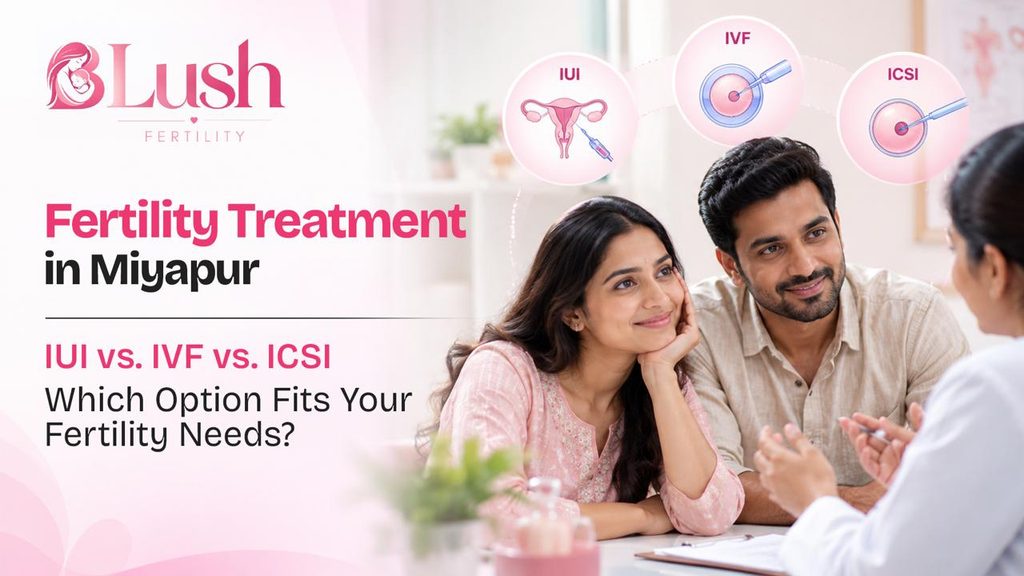
Starting your fertility journey can feel overwhelming, especially when medical terms like IUI, IVF and ICSI start coming up. If you’re exploring fertility treatment in Miyapur, you may be wondering what these treatments mean, how they differ, and which one is right for you.
While all three aim to help couples achieve pregnancy, each works differently and is recommended for specific fertility needs. Understanding the basics can make the journey easier to navigate and help you have a more informed conversation with your fertility specialist.
This blog explores the differences between IUI, IVF and ICSI, how each treatment works, and what couples should know before choosing a fertility treatment.
What Is IUI and Who Is It Usually Suggested For?
The idea behind intrauterine insemination (IUI) is simple. Sperm is washed and concentrated in the lab, then placed inside the uterus close to the time of ovulation. The sperm gets a shorter journey, which can help when sperm quality is mildly reduced, such as in cases of low sperm count or reduced sperm motility.
Doctors often suggest IUI for unexplained infertility, mild male factor issues, or irregular ovulation that responds to medicines. It is also used with donor sperm. Ovulation is usually tracked with scans, and tablets or injections may be added to help the ovaries release an egg. Fertility medicines can cause mild side effects, so your doctor will explain what to expect.
IUI works only when the fallopian tubes are open and the sperm quality is reasonable. If tests show blocked tubes, it is not the right fit. The procedure itself is quick, done in the clinic, and many women resume normal activities soon after.
What Happens in IVF, and When Is It Considered?
In vitro fertilization, or IVF, brings the meeting of egg and sperm outside the body. First, medicines help the ovaries produce several eggs. The eggs are then collected in a short procedure and mixed with sperm in the lab. The embryos grow there for a few days, and a healthy one is placed in the uterus. Extra good-quality embryos can sometimes be frozen for later use. Since the medicines and procedures need monitoring, expect several clinic visits during one cycle.
IVF is commonly considered when the tubes are blocked or damaged, when endometriosis or low ovarian reserve is affecting fertility, when the male-factor problem is more than mild, in cases of unexplained subfertility, or when IUI cycles have not worked after a reasonable number of attempts. Age also plays a part, which we will come to shortly.
Because the lab can watch fertilization and early embryo growth, IVF also gives the doctor more clues about what is going wrong. This is especially useful in unexplained subfertility, where routine tests show no clear cause. That is why some couples move to it sooner rather than repeating many IUI cycles.
How Is ICSI Different From IVF?
Many people imagine ICSI and IVF as two separate roads. In truth, ICSI is a technique used inside an IVF cycle. In ICSI, or intracytoplasmic sperm injection, an embryologist picks one healthy sperm and injects it directly into a mature egg under a microscope. Everything before and after, from egg collection to embryo transfer, follows the usual IVF path.
In regular IVF, many sperm are placed around each egg and one fertilizes it naturally in the dish. ICSI is often advised when the sperm count is very low, when movement or shape is poor, when sperm has to be collected surgically, or when an earlier cycle had poor fertilization. It can help when sperm alone may struggle to enter the egg, though it cannot promise fertilization. Not every IVF cycle needs ICSI. The doctor decides after studying the semen report and your history.
How Do You Choose the Right Fertility Treatment in Miyapur?
Honestly, you do not choose it alone, and you should not choose it from the internet. A doctor looks at several things together:
- The woman’s age and how long you have been trying
- Ovulation pattern and ovarian reserve
- Condition of the tubes and uterus
- The semen analysis report
- Earlier treatments or pregnancy losses
As a rough map, IUI suits milder problems when the tubes are open. IVF comes into the picture when tubes, endometriosis, ovarian reserve or repeated unsuccessful IUIs are involved. ICSI is added when sperm quality is the main worry. It is a map, not a rule, and your reports can change the route.
At Lush Fertility, Dr. Smitha Onteddu, the Chief Fertility Consultant, reviews your history and test results before a plan is suggested, so the treatment is matched to you and not the other way round.
Which Tests Come Before Any Treatment Decision?
Advice built on guesswork can waste precious months, so evaluation comes first. For women, this often includes hormone blood tests, an ultrasound scan of the uterus and ovaries, and a check on whether the tubes are open. For men, a semen analysis is the usual starting point. Most of these are simple outpatient checks. If a problem inside the uterus or pelvis is suspected, procedures like hysteroscopy or laparoscopy may be discussed. Only after these results does the IUI vs. IVF vs. ICSI question get a real answer. A simple semen report can change the whole direction of a plan.
Does Age Change the Treatment Choice?
Yes, often. Egg quantity and quality come down with time, especially after the mid-thirties. That is why doctors usually advise a fertility check after one year of trying, or after six months if the woman is over 35. For an older woman, the doctor may suggest moving to IVF sooner instead of waiting through several IUI cycles. The male partner’s age is also noted, though its effect is usually less sharp. A younger couple does not always start with IUI either. Test results guide that call, not the date of birth alone.
Is There a Best Treatment, or Only the Best Fit for You?
Couples often ask which treatment is the best one. IUI is not a weaker version of IVF, and IVF is not automatically better than IUI. The best treatment is the one that matches the reason you are not conceiving, along with your age, health, comfort and budget. Some couples conceive with IUI, while others need IVF with ICSI.
What helps most is an honest evaluation, clear explanations at every step, and a team that tells you plainly when a step is not needed. Questions about cost, medicines, number of cycles and time off work are all fair, so ask them early. Treatment can also feel long, and talking openly with your partner and your doctor makes the road lighter.
Frequently Asked Questions (FAQs) About the Fertility Treatment
Is IVF better than IUI?
Not always. IVF suits certain problems, like blocked tubes, while IUI can be enough for milder issues. The better option is the one that fits your test results.
Is ICSI the same as IVF?
No. ICSI is a technique used during IVF, where one sperm is injected into an egg. In IVF without ICSI, the sperm fertilizes the egg on its own in the dish.
Is IUI painful?
Most women feel little more than mild discomfort or cramping. The procedure is short and does not usually need anesthesia.
How many IUI cycles are tried before moving to IVF?
There is no fixed number for everyone. It depends on your age, test results and how earlier cycles went, and your doctor will guide you.
Can IUI work if the fallopian tubes are blocked?
No. IUI needs at least one open tube so that the sperm and egg can meet.
When should we see a fertility specialist?
After one year of trying to conceive, or after six months if the woman is above 35. Go earlier if you have irregular periods, a known condition or previous pregnancy losses.
Ready to Take the First Step?
Every fertility journey begins with the right guidance. If you’re unsure which option is best for you, start with a consultation. Dr.Smitha Onteddu and the team at Lush Fertility are here to understand your concerns, review your reports, and help you explore the right path forward.
Book your appointment today!
+91 9133541177