
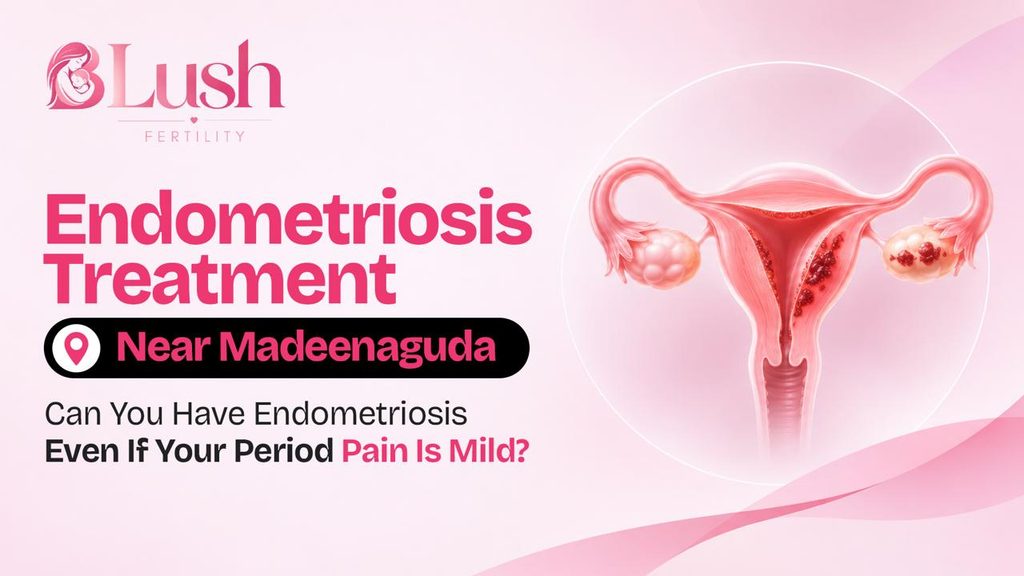
Your period pain is mild. You take a tablet, carry on with your day, and tell yourself it is normal. But what if mild pain is not the whole story? Many women assume endometriosis always means severe cramps. In reality, endometriosis is a condition where tissue similar to the uterine lining grows outside the uterus, and the pain it causes does not always match how serious it is. Some women with very little pain still struggle to conceive. If you are searching for endometriosis treatment near Madeenaguda, this blog explains the signs, the tests, and when to see a doctor.
Why Does Period Pain Not Always Show How Serious Endometriosis Is?
Think of endometriosis as tissue that wanders off. Cells similar to the lining of the womb settle on the ovaries, the fallopian tubes or the walls of the pelvis. Every month, these patches respond to hormones just as the womb lining does. They can irritate nearby tissue and cause inflammation.
Here is the surprising part. The amount of pain a woman feels does not always match the amount of endometriosis she has. One woman may have a few small patches and feel strong pain. Another may have more widespread disease and feel only a dull ache. Pain depends on where the patches sit, how close they are to nerves, and how each body reacts. That is why pain alone is a poor way to judge the condition.
Can You Have Endometriosis Even If Your Period Pain Is Mild?
Yes, you can. Mild pain does not rule it out. Some women have only a little discomfort, and a few have no pain at all. Because the cramps feel bearable, many never think of seeing a doctor. They get used to it, and that is where the delay begins.
Here are a few reasons mild symptoms get brushed aside:
- Period pain is often seen as normal, so women do not mention it.
- Painkillers keep the discomfort under control and hide the pattern.
- The main symptom may not be cramps. It could be heavy bleeding, tiredness or pain at a different time of the month.
- Friends and family say “everyone has cramps,” and the matter ends there.
None of this means every mild cramp is endometriosis. Most of the time it is not. But if your symptoms keep returning or slowly change, it is fair to ask a gynaecologist.
Which Other Symptoms Should Not Be Ignored?
Pain during periods is only one clue. Look out for these:
- Pain during or after sex
- Pain while passing stool or urine, mainly around your periods
- Heavy periods or spotting between periods
- Lower back or pelvic pain on days when you are not bleeding
- Bloating, nausea or tiredness that follows a monthly pattern
- Trouble getting pregnant after trying for some time
A simple habit helps. Note down your symptoms for two or three cycles, with dates and how strong the discomfort feels. A small diary gives your doctor a much clearer picture than memory ever will.
Why Do Some Women Learn About Endometriosis Only When They Try to Conceive?
This happens more often than people expect. A woman with mild symptoms lives for years without a name for them. Then she starts trying for a baby, and months pass without a pregnancy. A fertility check finally brings endometriosis into the picture.
Endometriosis can affect fertility in more than one way. It may cause inflammation in the pelvis, scar tissue that changes how organs sit, or cysts on the ovaries. In some women, it can block or distort the fallopian tubes. This does not mean pregnancy is impossible. Many women with endometriosis do conceive, with or without treatment. It only means that early evaluation gives you more options and more time to choose.
How Is Endometriosis Diagnosed?
Diagnosis usually starts with a conversation. Your doctor will ask about your periods, your pain, your bowel and bladder habits, and how long you have been trying to conceive, if you are. A pelvic examination may follow. An ultrasound scan, often done internally, can show ovarian cysts linked to endometriosis. Sometimes an MRI is advised for a closer look.
A normal scan does not always rule the condition out, because small patches can be hard to see. In such cases, doctors may suggest laparoscopy, a keyhole procedure that lets the surgeon see inside the pelvis, and treat visible patches during the same sitting if needed. Whether you need it depends on your symptoms, age and plans for pregnancy, so the decision is made case by case.
Where Can You Get Endometriosis Treatment near Madeenaguda?
If you live in or around Madeenaguda, Lush Fertility in Miyapur is close by. Dr. Smitha Onteddu, Chief Fertility Consultant at the clinic, looks at your symptoms, scan findings and family plans before suggesting a path. There is no single treatment that suits everyone.
Treatment generally falls into a few groups:
- Pain management: medicines to ease cramps and pelvic pain.
- Hormonal treatment: medicines that reduce the monthly activity of the patches. These are usually not suitable if you are trying to conceive right now.
- Surgery: removal of patches or cysts, often through laparoscopy.
- Fertility treatment: if pregnancy is your goal, options such as ovulation induction, IUI or IVF may be discussed, depending on your situation.
The right mix depends on your age, symptoms, how long you have been trying, and your partner’s tests. Your doctor explains the reason behind each step, so you never feel lost.
What Can You Do for Yourself While You Wait for an Appointment?
Small steps can make the days easier, though they do not replace treatment:
- Keep your symptom diary going.
- A warm compress on the lower belly may ease cramps for some women.
- Gentle movement, like a short walk, can help with stiffness and mood.
- Ask your doctor before taking pain medicine regularly.
- Do not wait if the pain suddenly becomes severe, the bleeding is very heavy, or you feel faint.
Why Is It Worth Listening to Mild Pain Early?
Endometriosis is a long-term condition, and it can change slowly over the years. Catching it early helps your doctor protect your comfort and, if you wish to have a child, your fertility options. Mild pain is not a reason to panic. It is simply a reason to ask a question. One consultation can either put your mind at rest or give you a clear plan, and both are worth the visit.
Frequently Asked Questions (FAQs) About the Endometriosis Treatment.
Can endometriosis be present with no pain at all?
Yes. Some women have no pain and only find out during a scan, surgery or a fertility evaluation.
Does mild period pain mean mild endometriosis?
Not necessarily. The level of pain does not reliably show how much endometriosis is present.
Does endometriosis always cause infertility?
No. Many women with endometriosis conceive naturally or with treatment. It can make conceiving harder for some, so early advice helps.
Which doctor should I see for endometriosis?
A gynaecologist, ideally one who also handles fertility concerns, such as Dr. Smitha Onteddu at Lush Fertility.
Is surgery always needed for endometriosis?
No. Many women are managed with medicines. Surgery is considered based on symptoms, cysts and pregnancy plans.
Have Questions About Your Period Pain? Book a Visit Today
If your periods feel off, even in a quiet way, book a consultation with Dr. Smitha Onteddu at Lush Fertility. The clinic is at 3rd Floor, Prime Estate, Plot Number 209, Behind Metro Bus Stop, Opp: Miyapur Metro Station, Pillar No: A/620, Mathrushri Nagar, Miyapur, Hyderabad. Call +91 9133541177 to book your visit.